
Indians Don’t Eat Enough Protein (Let’s Fix That)
There’s certainly nothing lacking in chutneys, curries, or naan — As Indians, we’ve always taken great pride in our cuisine, and who wouldn’t with such bold flavors and vibrant traditions? Yet despite the abundance of delicious food in India, researchers have found that 90% of Indians don’t get enough protein in their diet!
In fact, India had the lowest protein consumption among all countries in Asia, with the average consumption being around 50 grams a day. (Ignore the black line, because we’ll see later that this is half of what a healthy adult should eat!)
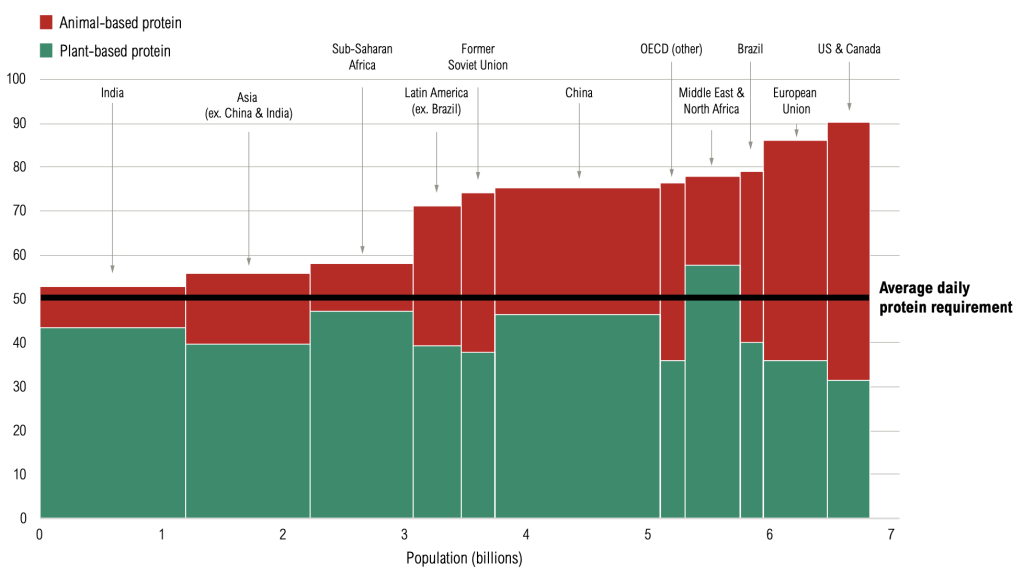
So, it’s safe to say that this is a HUGE public health crisis. Protein isn’t just a minor nice-to-have part of a diet. It’s an essential nutrient that plays a crucial role in maintaining good health.
In this blog post, we’re going to explore how a high-protein diet can help prevent malnutrition and related health problems in India and the downsides of low protein intake. We’ll also take a look at some high-protein vegetarian foods and sample meal ideas — so you can take charge of your health by the end of this post!
Why Do Indians Consume So Little Protein?
1. Meat Avoidance and Vegetarian Diets
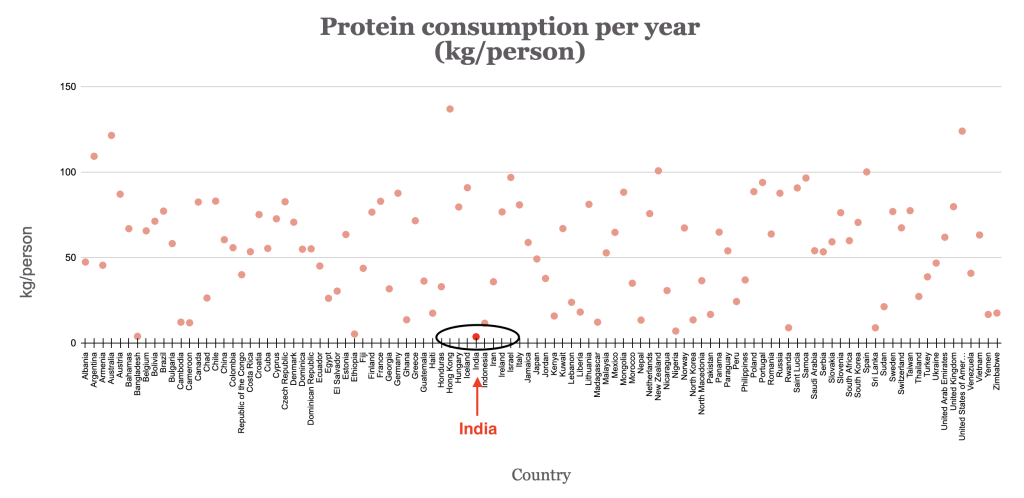
Did you know around 40% of Indians are vegetarians? On top of that, many of those who do eat non-vegetarian food restrict their meat consumption for religious and personal reasons. For instance, my family mostly reserves meat for special occasions and eats chicken, mutton, and eggs sparingly throughout the month. It’s little wonder why annual meat consumption per capita in India is a mere 3.78 kgs, compared to the United States (121 kgs), China (60.6 kgs), or the UK (79.9 kgs)!
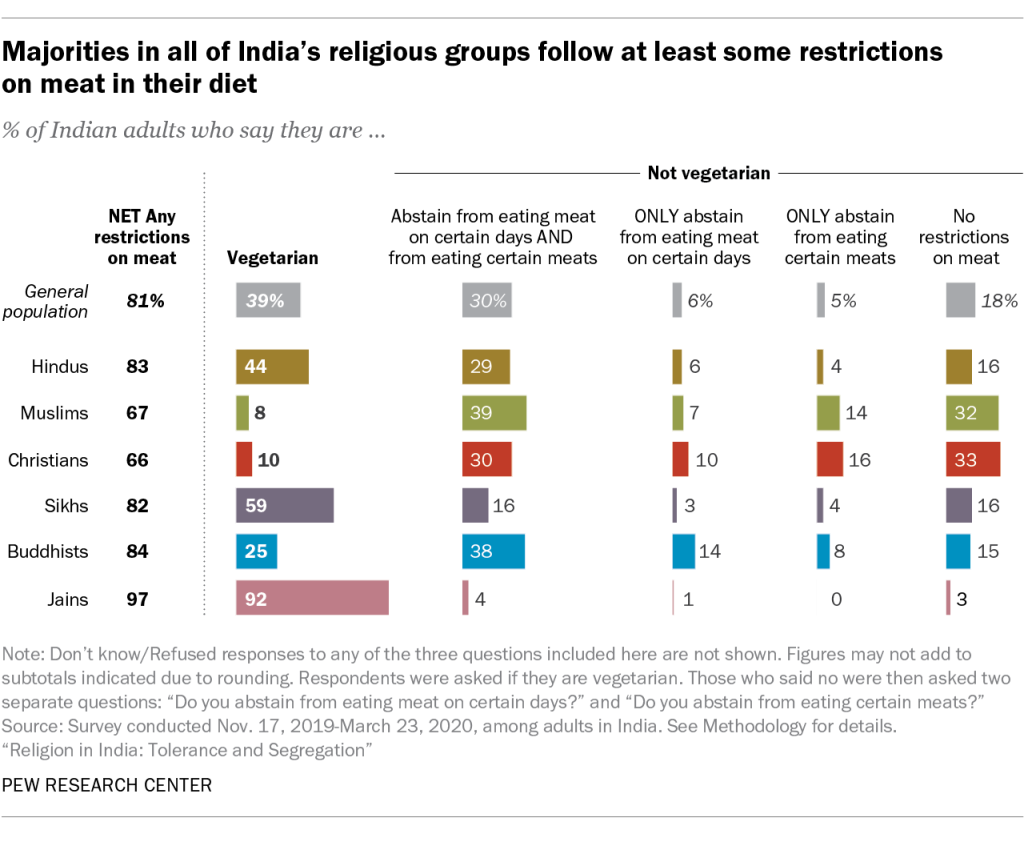
But if we do away with the all-or-nothing label of “vegetarian,” we can simply say more than 80% of the Indian population avoids meat most of the time.
And that’s important for one big reason — It’s much harder to get protein on a vegetarian diet. You can see why in the chart below, which compares protein in animal-based food vs. plant-based food.
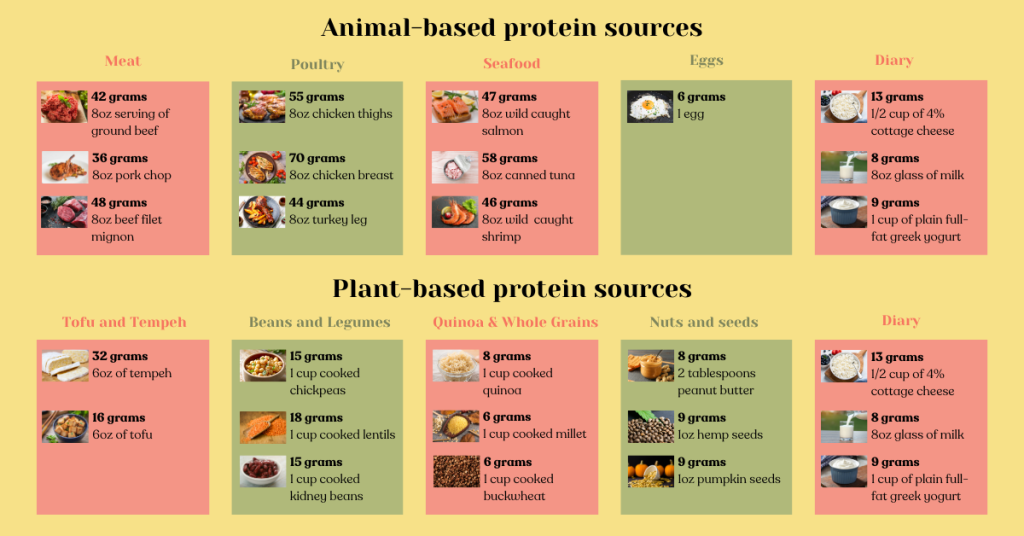
Since most Indians rarely eat meat, most of their protein comes from cereal-based products, which have poor digestibility. It’s no wonder, then, why Indians are so deficient in protein.
Let’s look at a few examples of common Indian vegetarian meals along with their protein content. Keep in mind that the average adult should have around 100 grams of protein a day — on top of that, the following vegetarian proteins aren’t “complete” (more on that later) and are difficult to digest.
Dosa with Coconut Chutney
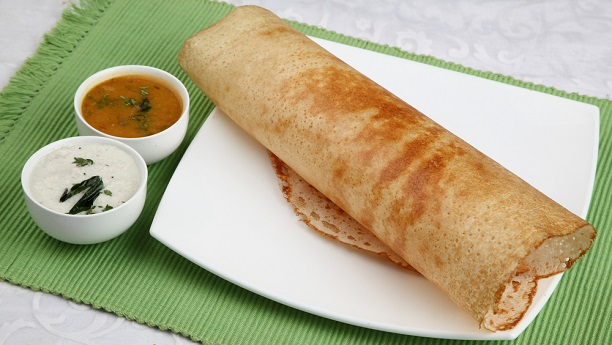
This is a popular breakfast dish. One medium dosa has 3.9 grams of protein, and a serving of coconut chutney has 1.3 grams of protein.
Total: 5.2 grams
Dal Tadka with Rice
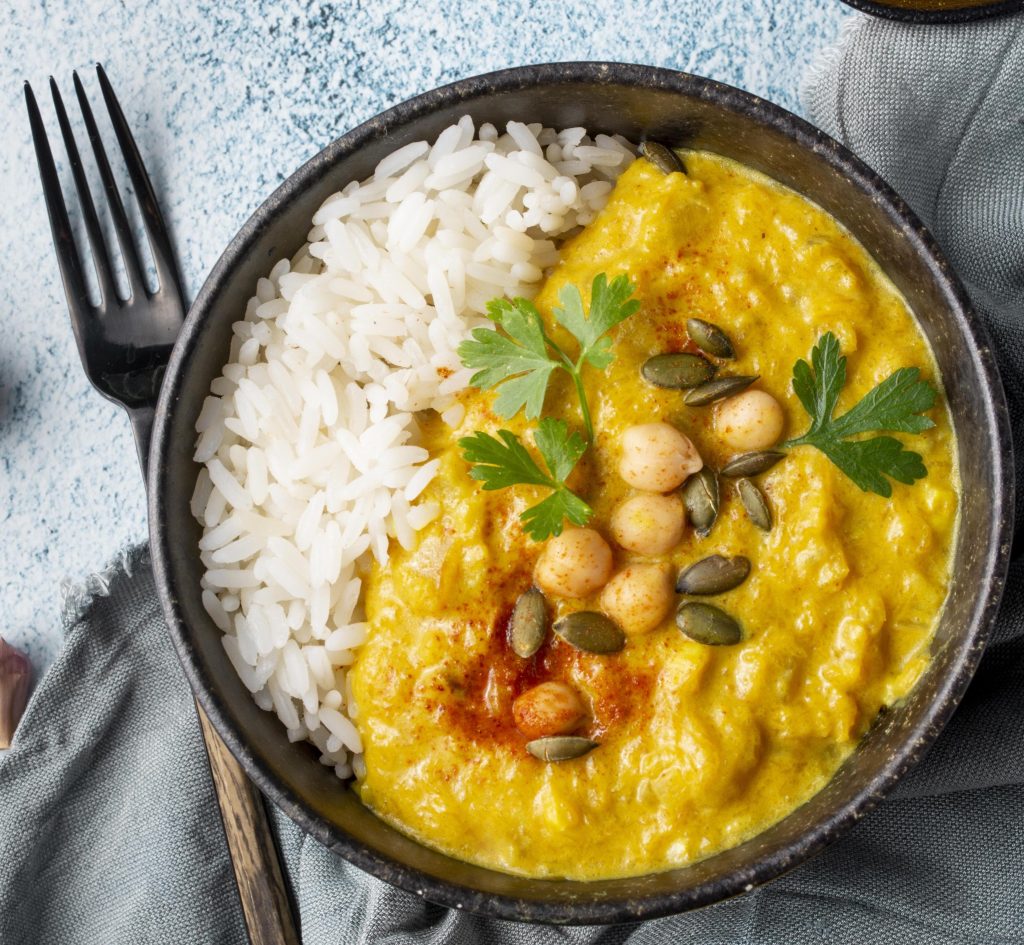
Dal is a popular curry made with lentils that’s eaten with rice or roti. A 5-oz serving of dal tadka has 7 grams of protein, and 1 cup of cooked rice has 4.4 grams of protein.
Total: 11.4 grams
Aloo Curry with Roti
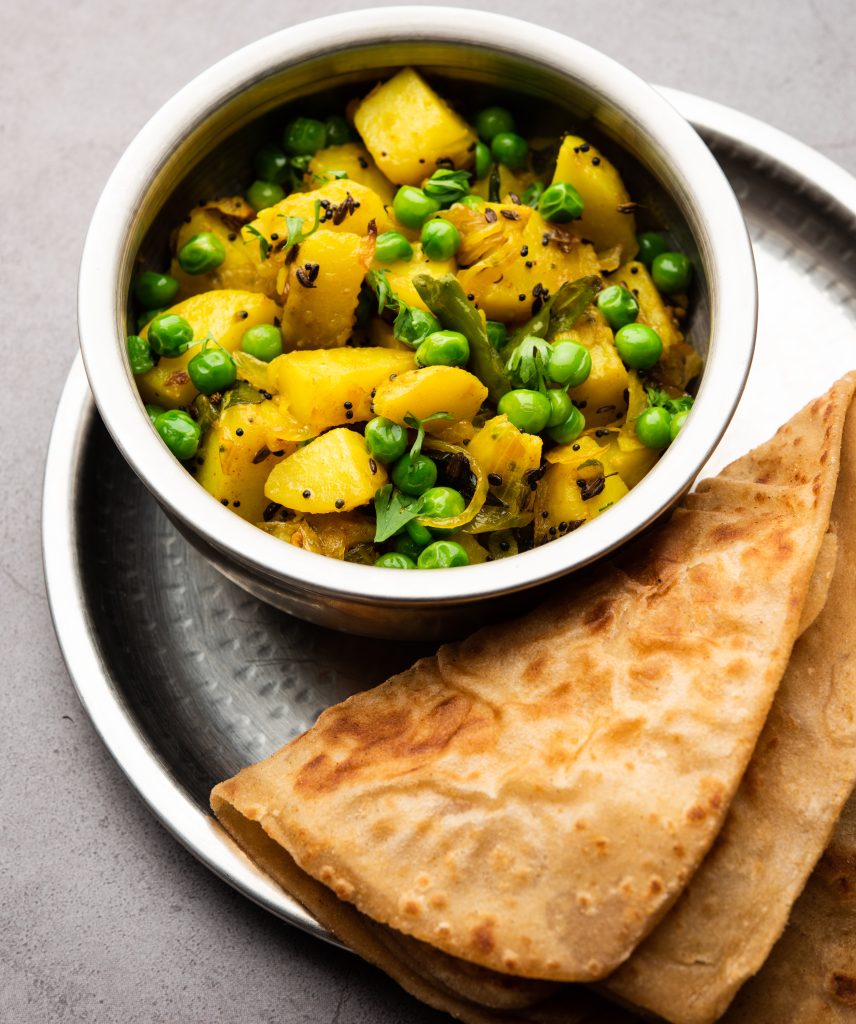
A curry made of potatoes, tomatoes, and spices, Aloo curry is often paired with rice or roti. A serving of Aloo curry has 2.9 grams of protein, and a 6-inch roti has 3 grams of protein. Assuming we eat two of them, that’s 6 grams.
Total: 8.9 grams.
Chana Masala with Rice
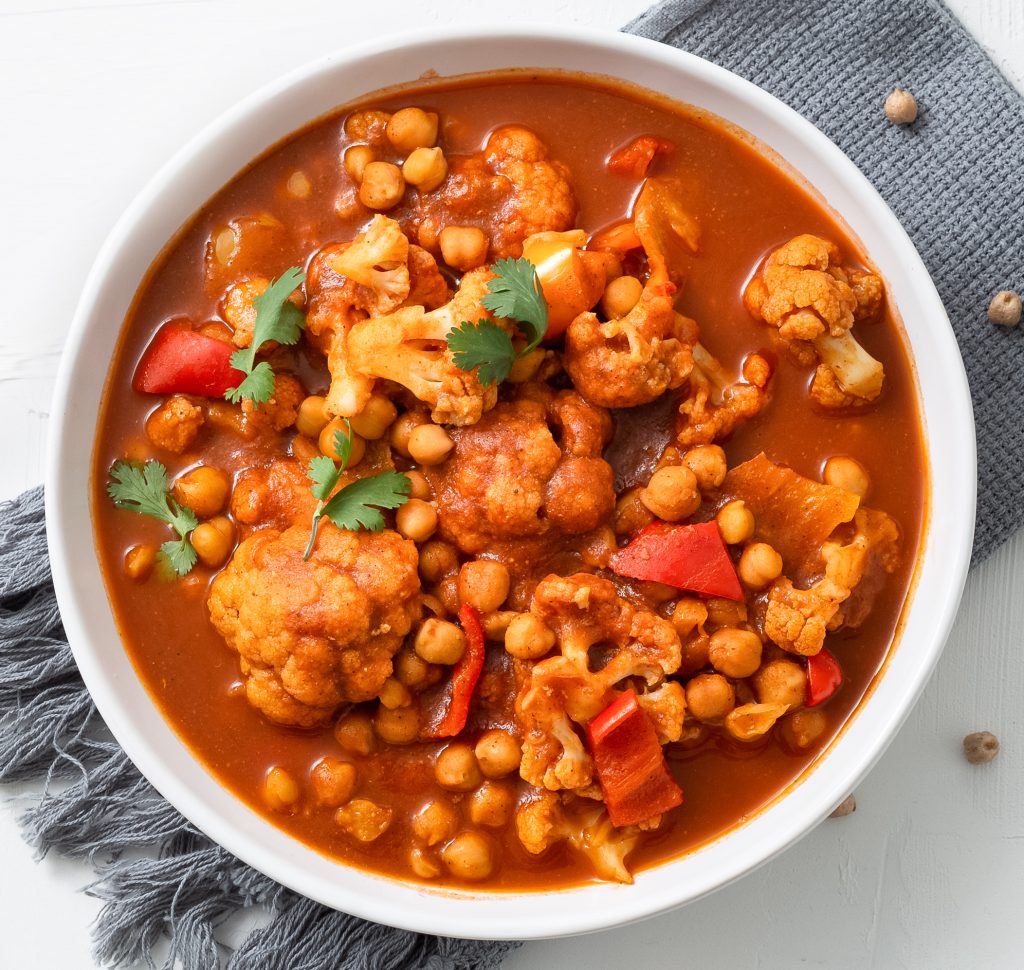
Chana masala is a curry made with chickpeas and spices. One serving has 5 grams of protein. A cup of cooked rice has 4.4 grams of protein.
Total: 9.4 grams.
Mutter Paneer with Naan
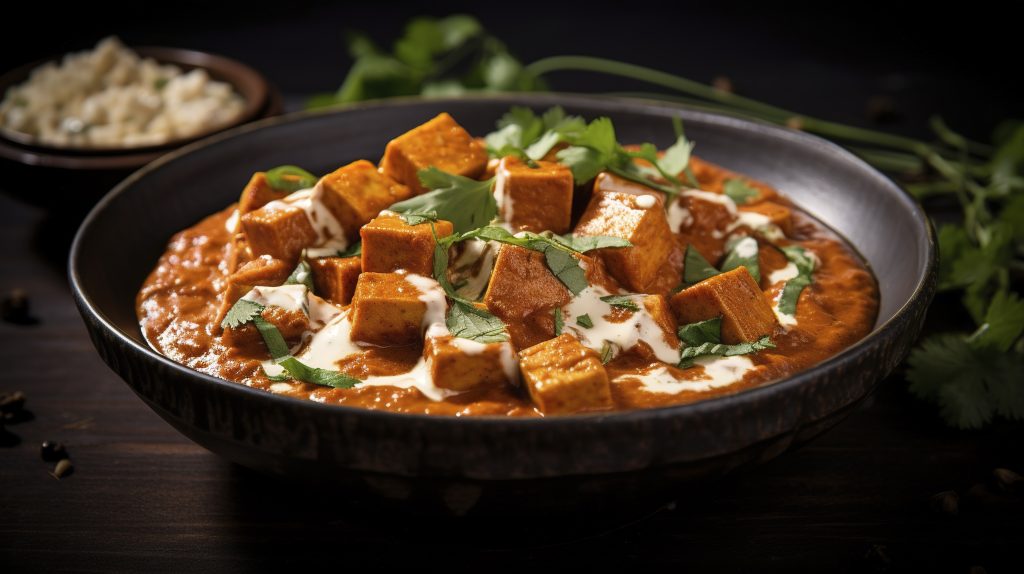
A curry made with vegetables and paneer, mutter paneer goes great with rice or naan. A 1-cup serving of mutter paneer has 11 grams of protein, and 1 serving of naan has 9 grams of protein.
Total: 20 grams
Curd rice
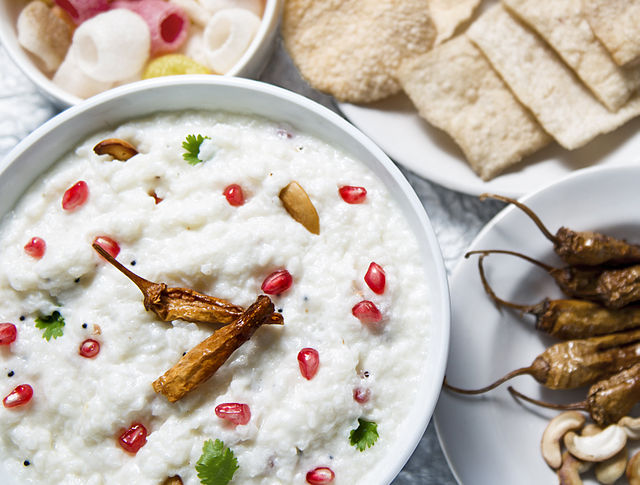
Curd rice is yogurt with rice and some spices. Often people will eat it as a meal (or sometimes have a small serving of it at the end of a meal). A serving of curd rice has 8.5 grams of protein.
Total: 8.5 grams
Clearly, you can see how each of these meals is under 10 grams of protein for the most part. As mentioned earlier, you’d have to eat an awful lot of these foods to get anywhere close to the minimum of 100 grams of protein a day. Not only that, but unlike animal sources of protein, these vegetarian proteins aren’t “complete” — meaning they don’t contain the nine essential amino acids.
“Nine amino acids—histidine, isoleucine, leucine, lysine, methionine, phenylalanine, threonine, tryptophan, and valine—are not synthesized by mammals and are therefore dietarily essential or indispensable nutrients.” – RDA
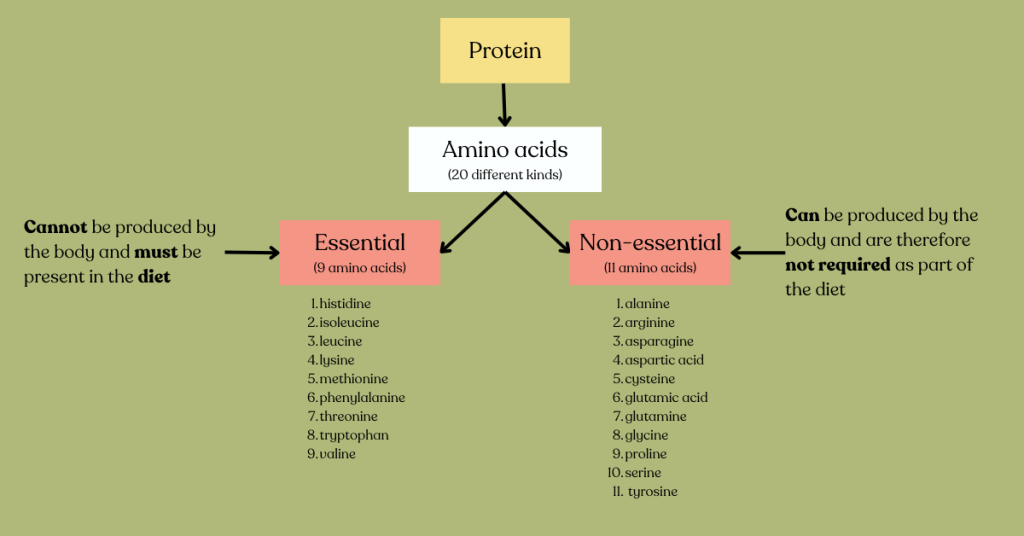
Our body needs all of the essential amino acids in protein to function properly, and the only way to get them is through food because the body cannot make these essential acids on its own. Since plant-based proteins don’t have all the essential amino acids, they’re called an ”incomplete source of protein.” To get all the essential amino acids, vegetarians have to mix and match different protein sources, making it much more challenging to meet your body’s requirements.
2. Commons Myths and a Lack of Knowledge
Most Indians aren’t sure how much protein they need, or they’re vaguely aware and just assume that if something has protein in it, it’s sufficient. For example, I’ve tried to explain to my family the importance of protein, but they’re reluctant to believe it. They have so much faith in their diet because it has been passed down for generations, and “changing” it is out of the question. But it doesn’t have to be challenging tradition so much as effectively choosing and pairing traditional foods to consume more complete proteins.
Likewise, a lot of people I meet in India believe in common protein myths. One big one is that vegetables or fermented foods, like dosa and idli, are packed with enough protein to meet their daily needs. This simply isn’t true. Another common myth is that only bodybuilders who are into building muscle need protein but the average Indian doesn’t. This also isn’t true, as we’ve seen in the data above. (What’s worse is that 97% of pregnant and lactating mothers are completely unaware of their protein needs!)
Still, I remember my grandma lecturing me on how rice makes you “strong” despite containing very little protein. Of course, rice is not harmful per day, but it needs to be part of a balanced diet — which traditional Indian cuisine is perfectly capable of achieving if we pick our foods intentionally.
3. Financial Concerns and Affordability
Even if myths or a lack of knowledge weren’t an issue, affordability would still be a hurdle to a balanced diet. Think about it: Carbohydrates are super cheap and accessible. A 20lb bag of basmati rice is between $20-30, which can produce 80 cups of cooked rice. For a family of 4 where each person eats two cups of cooked rice a day, the bag would last 10 days.
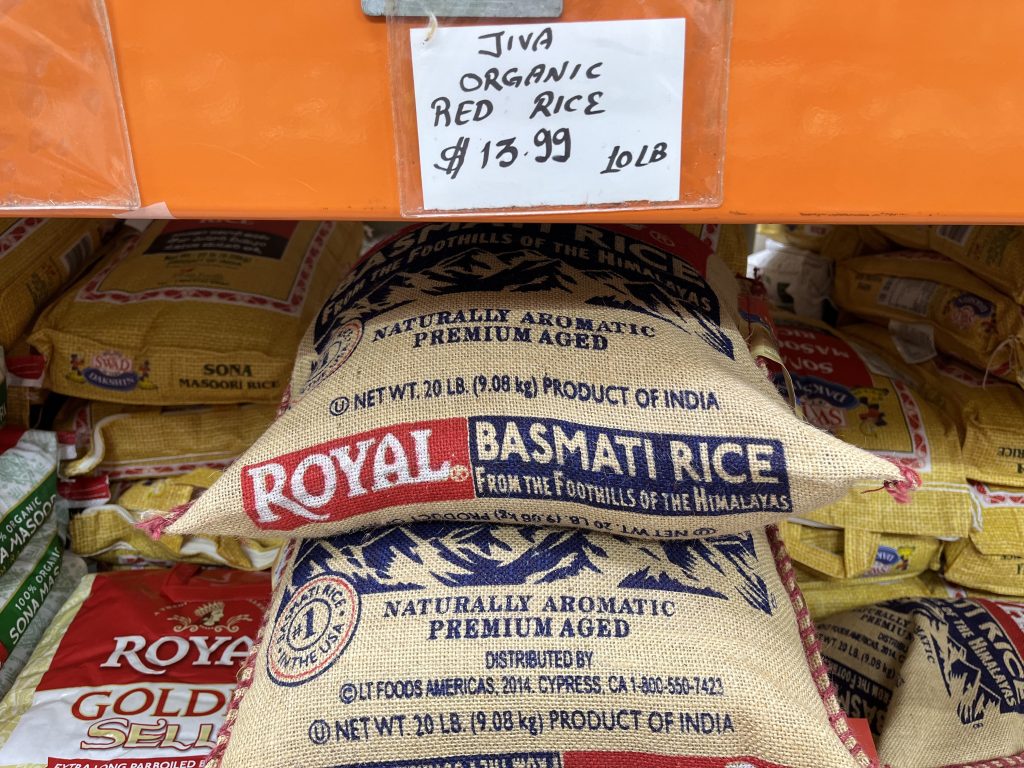
Compare that to 8oz of paneer, which is higher in protein but costs $6 and would only last one meal! There’s no contest. It makes sense why, when I visit some of my family in the poorer parts of India, they fill their plates with rice and very little curry. It’s the only economical way to feed themselves. Whether or not they knew about their urgent protein needs, they still must consider their urgent financial needs.
Why is Protein Deficiency So Harmful?
As I highlighted in my previous blog post, protein is essential for many bodily functions, including:
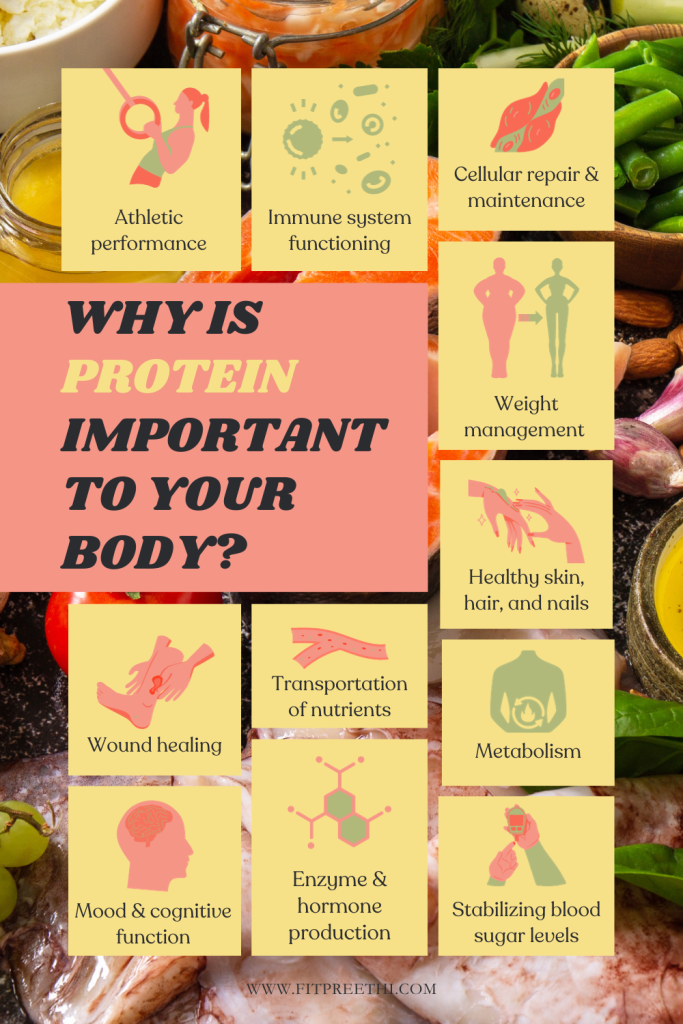
So, without complete proteins, it follows that these bodily functions can’t be adequately completed. Pretty scary, right? To highlight the real risk of protein deficits, let’s take a closer look at these possible harmful consequences.
1. Loss of Muscle Mass as You Age
For example, studies show Indians have very poor muscle mass as a result of not consuming enough protein. In fact, 71% of Indians between the ages of 30 and 55 suffer from a lack of muscle mass. It’s worth mentioning that we naturally lose muscle mass after the age of 30, so the last thing we want to do is further contribute to it! I can’t help but notice how frail many of older adults in India are. Their bones and veins are protruding from the lack of muscle, and they’re barely able to walk because of their frailty. Muscle is power. The longer you can keep it on you, the better you’ll age and the more comfortably you’ll live.
2. Heightened Risk for Diseases like Diabetes
Diseases like diabetes are on a steep rise in India, and, as you’ll see, the unique qualities of the Indian diet play a role in it. After all, the Indian diet consists primarily of carbs, vegetables, and fruits. While fruits and vegetables contain a lot of nutrients, they’re mostly carbohydrates without protein.
Eating only carbohydrates in a meal will spike your blood sugar and lead to poor blood sugar balance, which, over time, leads to diabetes. You can see then how even frequently consuming “healthy” foods like vegetables and fruits can still have adverse health consequences if the overall diet isn’t balanced.
3. Lifelong Damage to Children During (And After!) Pregnancy
Protein intake is especially important for growing children and pregnant mothers. Numerous studies show that not getting enough protein (and hence essential nutrients) while pregnant leads to a much higher risk of embryonic losses, preterm birth, and low birth weight. Moreover, protein intake during early childhood has lifelong consequences — nutritional damage during pregnancy and early childhood is irreversible.
You can see, then, why it’s so important to ensure Indian moms and Indian children get enough protein. Otherwise, their growth is stunted for life. In fact, according to WHO, India has the second-highest fraction of children under five who are radically underweight for their height, and 42.5% are underweight. Poverty is certainly one reason, but that doesn’t explain why countries like Yemen, Eritrea, Somalia, and Sudan are all doing better than India. (Hint: Protein intake plays a huge role here).
4. Weight Issues in Low-Protein Adults
India has seen a prolific rise in overweight and obese populations, similar to Western countries.
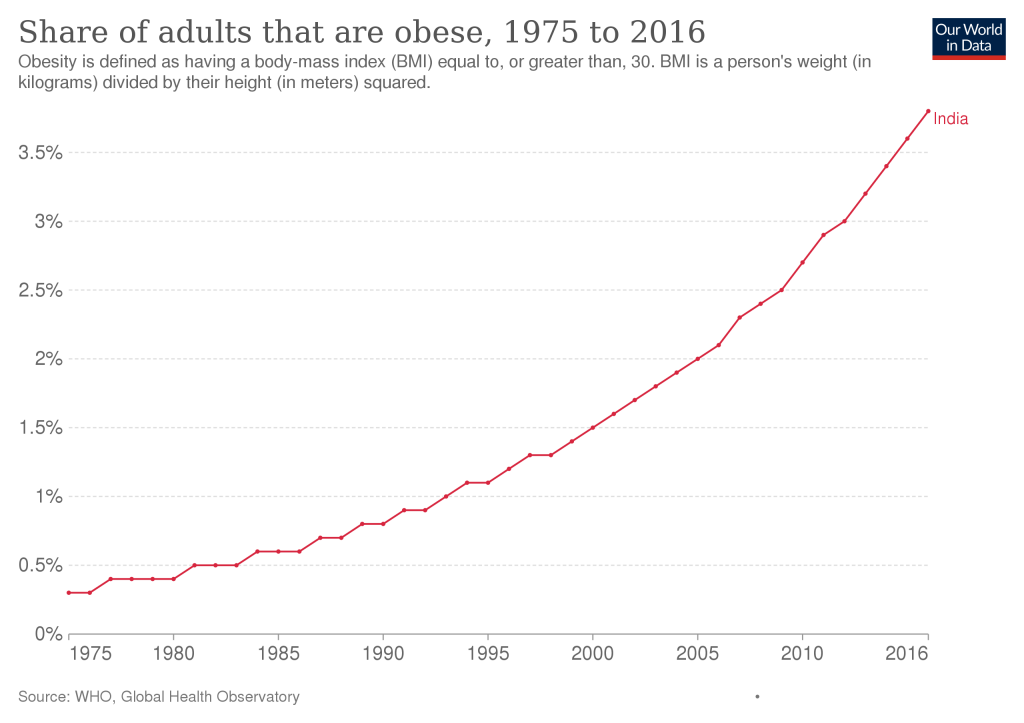
Based on the current trend in India, studies estimate that 28% of the population will be overweight and 5% will be obese by 2030. Anecdotally, I was shocked when I went back to India in 2019 after 10 years away. As a child, it was rare to see overweight people. But as an adult, I began seeing this much more frequently.
There’s no doubt diet plays a huge role in this epidemic. Eating tons of carbs while living a modern sedentary lifestyle is a perfect formula for obesity. This has been true in the West for the last three decades and is now becoming a reality in India.
How does this relate to protein intake? Well, if Indians consume enough protein, we should see an improvement in health markers across the board because not only does protein have essential amino acids necessary for the body to function properly (eg., blood sugar balance and increased metabolism), but it also has a satiating effect and leads to fewer cravings. In other words, you’ll feel fuller longer and won’t need to keep grabbing more carbs to fuel your body. As a result, you can manage your weight.
5. Many, Many More Consequences…
There are many other reasons why a lack of protein leads to health issues. It can lead to a weakened immune system, poor hair and skin health, low energy levels and fatigue, poor concentration, mood swings, bone and joint pain, slow wound healing, swelling in the arms and legs, poor sleep, and even an increased risk of all-cause mortality! (source, source, source)
So, How Much Protein Do You Need?
Now that you understand how important protein is, let’s determine how much protein a typical Indian should consume daily. According to the dietary guidelines, the Recommended Dietary Allowance (RDA) is 0.36 grams of protein per pound of body weight (or 0.8 grams per kilogram of body weight). For instance, if someone weighs 140 lbs, they should consume 50 grams of protein at the bare minimum daily. However, studies show that doubling this amount is optimal. This means consuming around 0.7 grams of protein per pound (or 1.6 grams per kilogram of body weight). Therefore, the 140lb individual would ideally consume 100 grams of protein daily.
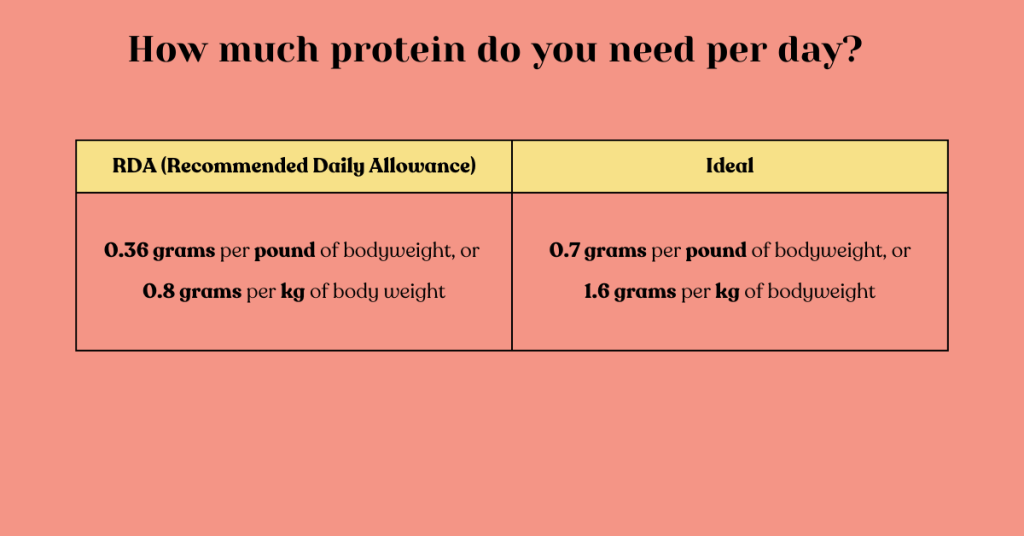
Personally, I consume around 120 grams of protein per day, which is about 0.9 grams per pound of body weight. I like eating red meat, which is high in protein. However, research indicates that there isn’t much benefit to having additional protein than what is required. Every person needs to experiment with their own body to determine how much protein they need each day to feel their best. That being said, consuming 100 grams of protein daily is a great goal for the average person!
Where Can You Get Vegetarian Indian Food That is High in Protein?
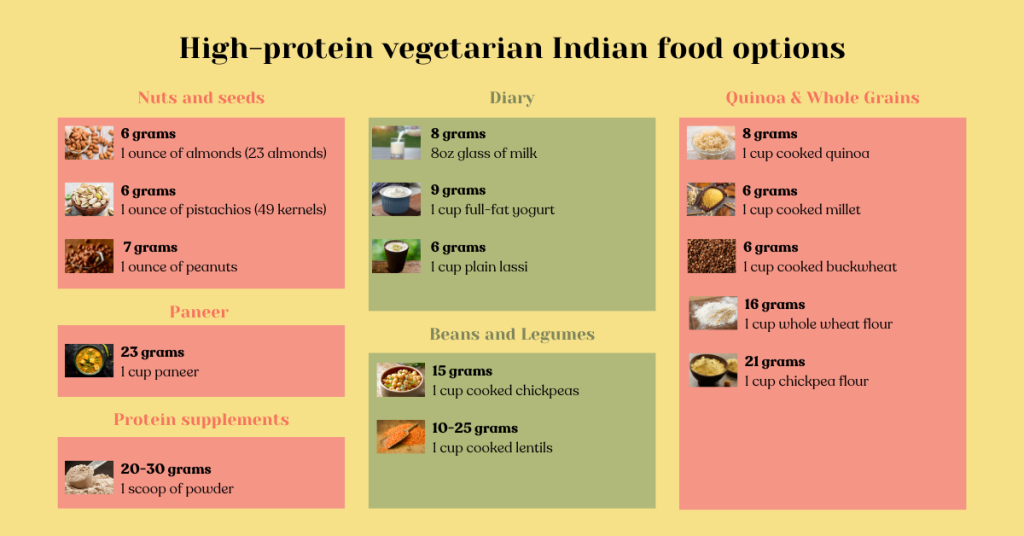
As a vegetarian, getting enough high-quality protein is challenging but not impossible! You’ll just have to put a bit more thought and planning into your meals than a meat-eater would. Here are some of the best sources of protein for Indians on a vegetarian diet:
Beans and Legumes
- 1 cup cooked chickpeas = 15 grams of protein
- 1 cup cooked dal = 10-25 grams of protein (depending on the type of dal)
Paneer
- 1 cup paneer = 23 grams of protein
Quinoa and Other Whole Grains
- 1 cup cooked quinoa = 8 grams of protein
- 1 cup cooked buckwheat = 6 grams of protein
- 1 cup cooked millet = 6 grams of protein
- 1 cup whole wheat flour = 16 grams of protein
- 1 cup chickpea flour = 21 grams
Dairy products
- 8 oz of milk = 8 grams
- 1 cup full-fat yogurt = 9 grams
- 1 cup plain lassi = 6 grams
Nuts and seeds
- 1 ounce of almonds (23 almonds) = 6 grams of protein
- 1 ounce of pistachios (49 kernels) = 6 grams of protein
- 1 ounce of peanuts = 7 grams of protein
Protein supplements
- 1 scoop of powder = 20-30 grams of protein
Note: I purposely didn’t list soy products because they are estrogenic and carcinogenic.
Sample Meal Plans
Now that we have a list of high-protein foods that Indians eat, let’s use these as a base for creating some high-protein vegetarian Indian meals! Here are just a few examples of how you could plan your meals to get at least 100 grams of protein a day.
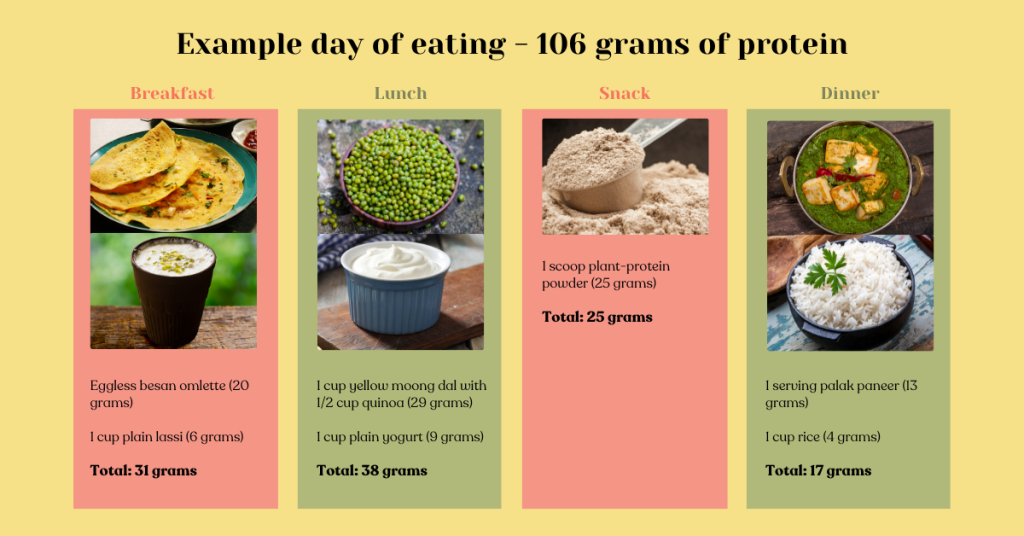
Day 1
Breakfast
- Eggless besan omelet (20 grams of protein)
- 1 cup plain lassi (6 grams of protein)
- Total: 26 grams protein
Lunch
- 1 cup yellow moong dal with 1/2 cup quinoa (29 grams of protein)
- 1 cup plain yogurt (9 grams of protein)
- Total: 38 grams
Snack
- 1 scoop plant-protein powder (25 grams
- Total: 25 grams
Dinner
- 1 serving palak paneer (13 grams)
- 1 cup rice (4 grams)
- Total: 17 grams
Total for the day: 106 grams
Day 2
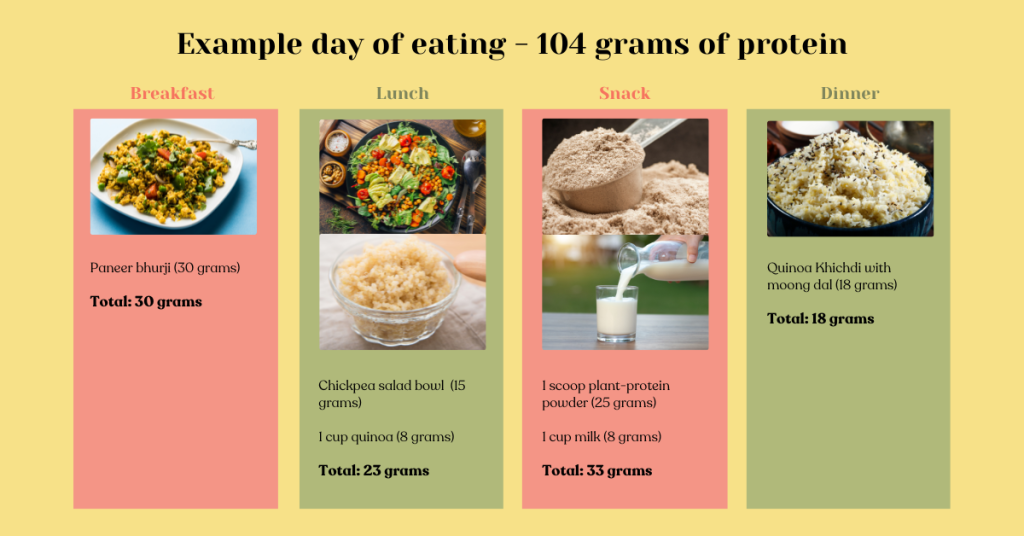
Breakfast
- Paneer bhurji (30 grams)
- Total: 30 grams
Lunch
- Chickpea salad bowl (15 grams)
- 1 cup quinoa (8 grams)
- Total: 23 grams
Snack
- 1 scoop plant-protein powder (25 grams)
- 1 cup milk (8 grams)
- Total: 33 grams
Dinner
- Quinoa Khichdi with moong dal (18 grams)
- Total: 18 grams
Total for the day: 104 grams
Day 3
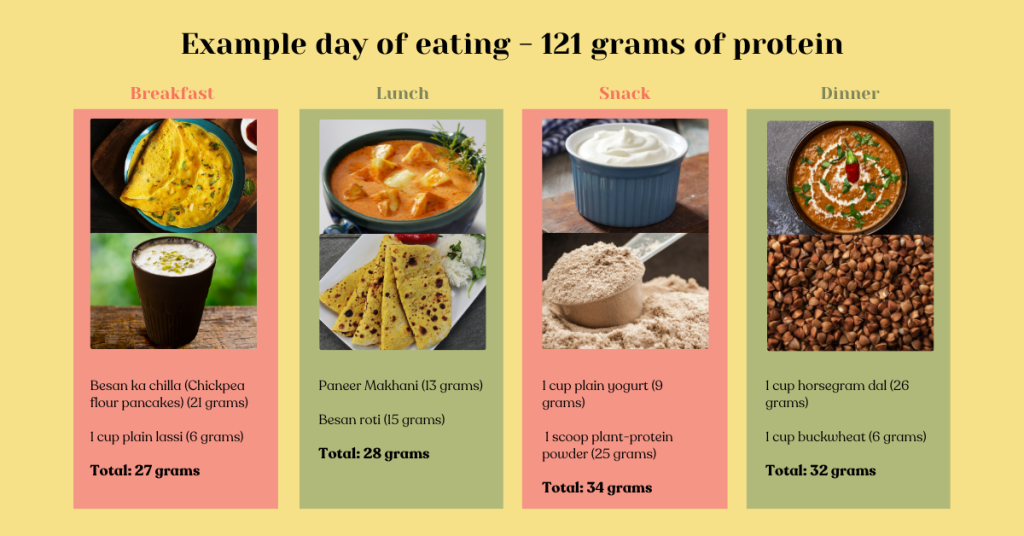
Breakfast
- Besan ka chilla (Chickpea flour pancakes) (21 grams)
- 1 cup plain lassi (6 grams)
- Total: 27 grams
Lunch
- Paneer Makhani (13 grams)
- Besan roti (15 grams)
- Total: 28 grams
Snack
- 1 cup plain yogurt (9 grams)
- 1 scoop plant-protein powder (25 grams)
- Total: 34 grams
Dinner
- 1 cup horse gram dal (26 grams)
- 1 cup buckwheat (6 grams)
- Total: 32 grams
Total for the day: 121 grams
Some Quick Tips to Meet Your Protein Needs
It should be clear now that, with a bit of diligence, you can have plenty of protein without compromising your vegetarian diet. Note that I added a scoop of plant-protein powder each day to boost intake, but if you don’t like protein powder, you can easily find other high-protein substitutes, like Greek yogurt. Before we close up, I want to leave you with some final tips and tricks to hit your protein goals!
1. Start with the Source.
I’ve noticed many people fill their plates up with rice, idli, roti, or some grain-based food, and then have just a dollop of curry to dip it in. Start thinking in reverse. You want the protein-rich food to be the base of your meals, not the carbs. You’ll notice how I assumed 1 cup servings of dal, chickpeas, or paneer for each meal. This is a lot more protein than most Indians are used to eating, but that is the point. By eating more of the protein base, you will naturally eat less carbs. So, start with the source!
2. Dal Has Lots of Carbs, Too!
Yes, dal is often the go-to protein source for Indians. But you must be mindful that it’s also very high in carbs. For example, 1 cup of green moong dal has 16 grams of protein — but also a whopping 42 grams of carbs. If you pair it with a carb source like rice or roti, it adds up even more. You can see how it becomes challenging to balance macros on a vegetarian diet. Of course, keep enjoying dal! Just remember that it’s high in carbs. For best results, choose horsegram dal which is much higher in protein than other types of dal.
3. Paneer is High in Fat!
In a similar vein, paneer is another go-to source of protein for Indians, but it’s important to remember that it also has a lot of fat. For example, while 1 cup of paneer has 23 grams of protein, it also has a whopping 27 grams of fat. Relying too heavily on paneer can easily lead to excess caloric intake — so, again, enjoy it, but be mindful, especially if you have weight loss as a goal.
4. Eat High-Protein Grains and Flours.
Why use wheat flour to make roti when you can use chickpea flour, which has 33% more protein in it? Why eat rice when you can eat quinoa or buckwheat, which has double the protein?! Seeing that the Indian diet is already so deficient in protein, it’s worth squeezing every opportunity you can. Stick to chickpea flour, quinoa, buckwheat, or millet when possible. Whole wheat flour is fine once in a while, but just stay away from all-purpose flour or plain rice!
5. Limit the Vegetable Curries.
If you want to get enough protein, you NEED to have paneer or dal in every curry you eat. Eating vegetable curries just won’t cut it. If you like the taste, have some for fun, but don’t fill up on them. They don’t add anything to your daily protein requirements. If you do eat vegetable curries, cook with vegetables that have some protein, such as asparagus and spinach, which have 4 to 6 grams of protein per cup (cooked).
6. Dairy is Your Friend.
As a vegetarian, dairy will be one of your biggest sources of protein (e.g., paneer, milk, yogurt). Personally, I like to stick to full-fat versions because studies show that full-fat dairy helps boost female fertility (compared to low-fat versions, which can actually harm female fertility). However, if you’re male or already get plenty of fat from dairy sources, adding a serving of low-fat dairy per day probably won’t hurt you, and it would immensely boost your protein intake. For example, 1 cup of low-fat Greek yogurt has 20 grams of protein (compared to 1 cup of full-fat Greek yogurt, which has 10 grams).
7. Track your meals.
Sure, meal tracking will take an extra 15 minutes of your day, but the payoff is more than worth it. MyFitnessPal is a food-tracking app with a large database of Indian foods, both home-cooked and restaurant-made. It also allows you to scan barcodes and add custom recipes, making it easy to track your meals. Another popular app is HealthifyMe. HealthifyMe has a database of over 100,000 Indian foods. It also has a feature called “Snap It” that allows you to take a photo of your meal, and it will automatically identify the food and calculate the calories. This will help ease the time-cost of tracking so you can stay healthy and productive.
8. Stay hydrated.
When I eat higher protein meals, I tend to get thirstier. This is likely because protein metabolism produces waste products, which are excreted by the kidneys and require water. Additionally, the enzymes and digestive juices that break down proteins rely on water, and since the thermic effect of protein is higher (it requires more energy to break down protein compared to carbs or fat), the body may require more hydration. Make sure to stay hydrated to keep things moving.
9. Use a Protein Powder if Needed.
Protein powder is useful for vegetarians, given how difficult it is to reach their intake requirements from plants. If you’re going to include protein powder in your daily diet, look for brands that use a mix of plant proteins that create a complete protein — that way, you can get all your essential amino acids. The Garden of Life brand is a good choice overall.
10. Stick with it for a Month.
New habits take time to become second nature, but you’ll get there eventually! Just remember that it’ll get easier. Resist the temptation to grab quick low-protein snacks or take “cheat days” for at least a month. After that, you’ll find that you’re feeling and looking better than ever. That will be a strong motivator to stick to your new protein-rich diet. Trust me!
11. Don’t Obsess Over it!
I know I told you to track your meals, but there’s no need to become obsessive. Meals are meant to be enjoyable. Don’t develop an unhealthy relationship with food. If you have cookies or ice cream once in a while, it’s alright — as long as you’re getting enough protein-rich foods each day. You’re allowed to enjoy your food!
Conclusion
Hopefully, this post gave you a crystal-clear idea about why protein is so important for optimal health and how, as Indians, we’re uniquely at risk of consuming too little of it. It turns out it’s more than possible to get plenty of protein on an Indian (and even vegetarian) diet! If you found this helpful, I hope you’ll share it with your friends and family. It’s time to take a step in a healthier direction — while still enjoying the rich and delicious cuisines that we all know and love.
As always, if you have questions, please don’t hesitate to ask in the comments.


But estrogen found in soy products is not as effective as the estrogen found naturally in our body, I’ve read somewhere that it doesn’t cause any kind of hormonal disbalance, what are your opinions on this?
best to avoid over-consuming soy products. Feel free to share the link where you read it is not disruptive to hormones and I’ll take a look.
Hi,
I think you may to verify the protein quantity in chana masala.
If you look up chick pea macros on the prospex site (https://www.prospre.io/ingredients/chickpea-62337) or even the USDA site (https://fdc.nal.usda.gov/fdc-app.html#/food-details/173756/nutrients), you’ll see that a 100 grams of chickpea consists of ~19/20 grams of protein.
You’re looking at raw. I am looking at cooked. Very different.
Excellent article! I have a theory that high carb low protein food meals such as “curries” with roti/rice are more of a recent trend in Indian cuisine, possibly triggered by malnutrition and poverty in the previous two centuries. Like, if you’re in survival mode why would you care about variety? You’re probably going to try and grow/hoard as much of a couple of instant energy foods (like sugar, wheat and rice) as you can.
The ancestors before ate a bigger variety of high protein flours and whole grains supplemented by nuts, sprouts, raw dairy, vegetables and fermented foods. Loved the sample meals you wrote down at the end!
you are probably right. India was wealthier in the past so it makes sense they ate more variety and protein (which is more expensive)